Springtime Splendor in the Himalayas
Bhutan
May 1 to 16, 2028
 Private Trip Available
 Safari Overview
Travel over scenic Himalayan passes surrounded by courting birds amid springtime flowers and experience a colorful Buddhist festival. May places you in Bhutan during the height of the spring courting season, a birder’s paradise where up to 400 species are possible and conditions are ideal for spotting the rare Satyr Tragopan. Traveling through this mountainous gem draped in blooming rhododendrons, you’ll be immersed in Bhutan’s rich culture, evident not only in its distinctive architecture and abundant prayer flags but in its deep reverence for the natural world. Visit dzongs and monasteries, including a hike to the famous cliff-side Tiger’s Nest Monastery. Guided throughout by our Bhutanese leader, Hishey Tshering, you will experience the wonder and beauty of Bhutan in full spring bloom.
Why Choose This Trip?
- Experience Bhutan’s Living Culture: Explore centuries-old monasteries, remote villages, and majestic dzongs—including a hike to the iconic Tiger’s Nest Monastery—for a deep immersion in Himalayan Buddhist traditions.
- Journey Through Stunning Himalayan Landscapes: Cross dramatic mountain passes such as Dochula, Pele La, and Thrumshing La, taking in sweeping views, varied forest zones, and the breathtaking natural beauty of Bhutan.
- Spot Rare Wildlife in Protected Habitats: Discover Bhutan’s rich biodiversity in national parks, where you may encounter golden langurs, red pandas, and a dazzling array of Himalayan bird species.
- Witness Peak Rhododendron Bloom: Travel during one of the best windows of the year, when Bhutan’s forests and high passes light up with blooming rhododendrons in a full range of colors.
- Enjoy Ideal Trekking and Travel Conditions: Take advantage of Bhutan’s mild May temperatures and pre-monsoon stability for comfortable, scenic hiking.
⭐⭐⭐⭐⭐ “The trip was documented well for what was needed and the guide was presented with skills and knowledge that would interest me. The guide and two assts were knowledgeable and caring. Service by them was top notch. I choose Cheesemans due to my experience and confidence in them to present a trip that is safe and complete in providing the travel documentation and instructions for which to be prepared.“ – Pat B. |
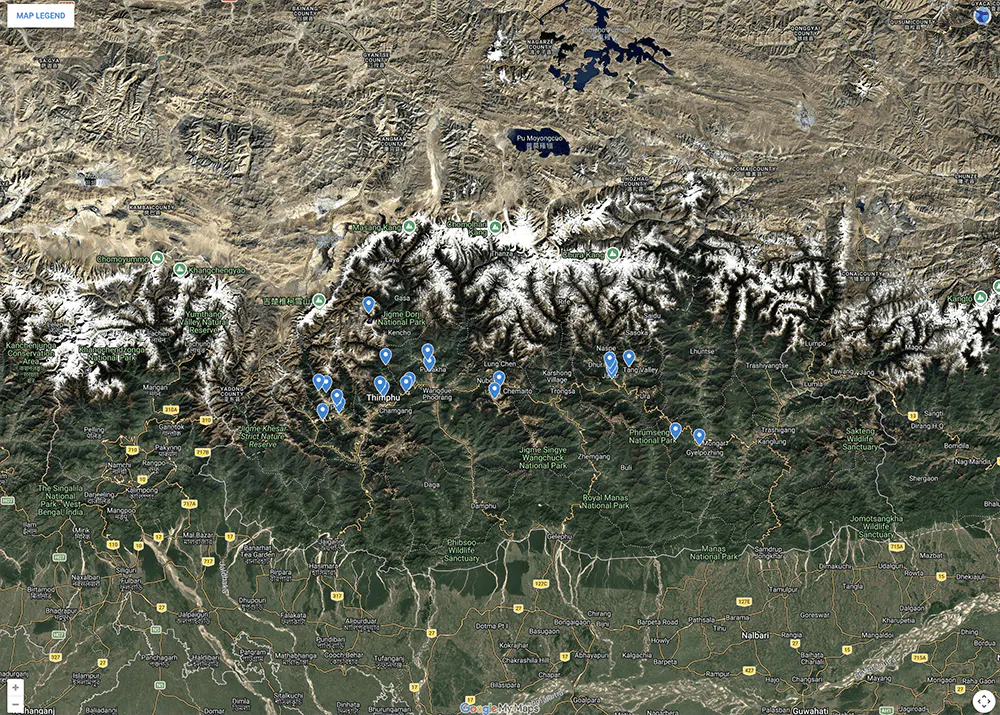
TRIP MAP
NOTABLE EXPERIENCES
 |  |  |
Itinerary Updated: September 2026


FAQ
| Date | Description | Lodge | Meals |
|---|---|---|---|
| May 1 | Arrival and drive to Thimphu. Fly from Bangkok, Thailand to Paro, Bhutan and then drive to Thimphu. | Hotel in Thimphu | L, D |
| May 2–15 | Explorations of Bhutan. Experience the wild beauty and cultural richness of Bhutan on this immersive journey from west to east. Travel through spectacular landscapes ranging from subtropical forests to high mountain passes and visit some of the country's most important wildlife areas, including the birding hotspot of Yongkhola. Along the way, search for rare and charismatic species like the Beautiful Nuthatch, Satyr Tragopan, and Ward's Trogon. Enjoy hikes to sacred sites such as the Tiger's Nest Monastery and Khamsum Yulley Chorten and explore traditional villages. This journey offers a unique blend of natural discovery, cultural insight, and scenic adventure through one of the Himalaya's most enchanting and ecologically rich countries. | Various lodges in Bhutan | B, L, D |
| May 16. | Fly from Paro to Bangkok to connect with flights home. | B |
Get the Full Daily Itinerary
Our Trip Leaders
![]() Hishey Tshering
Hishey Tshering
 Hishey Tshering
Hishey Tshering is a passionate birder, devoted football (soccer) enthusiast, and committed conservationist. He served as the Communications Officer for the Royal Society for the Protection of Nature (RSPN), where he played a key role in safeguarding the Black-necked Cranes. In 1998, Hishey collaborated with Dr. George Archibald, co-founder of the International Crane Foundation, on the groundbreaking first-ever color-banding and radio-collaring of these cranes to track their migratory patterns.
- Cost & Payments
- Included
- Not Included
- FAQ
- Climate
- Fitness Level
- Accommodations
- Transportation
- Flights
 Conservation
- Conditions
Cost & Payments
Costs (in US$)
| Type | Cost Per Person |
|---|---|
| Trip Cost, double occupancy | $9,300 |
| Single Supplement | $650 |
Costs are per person, double occupancy, not including airfare, singles extra. See Included and Not Included sections for more details.
If you are a single traveler, we will try to find a roommate for you, but if we cannot pair you with a roommate, we may charge you a single supplement. Single rooms cost extra and are subject to availability.
Payment Schedule
| Payment | Due Date | Amount Per Person |
|---|---|---|
| Deposit | Due now to reserve your space | $500 |
| Final | November 23, 2027 | Remaining Balance |
Payments are due based on the schedule above. All reservations require a deposit to confirm reservation of your space.
Cancellations
Until the Final Payment due date, deposits are refundable except for a cancellation fee of $150 per person, which can be applied toward another trip if reserved within six months of the canceled trip’s departure date. Cancellations are non-transferable. No refunds are given after the Final Payment due date.
Included
- Carbon offsets for the duration of this trip.
- All leaders, transport, park entry fees, and permits for all activities unless described as optional.
- Sustainable Development Fee ($100 per person per day).
- Transfers in Bhutan.
- One internal flight (Bumthang to Paro).
- Bhutan visa fee.
- Accommodations for the nights of May 1 through 15.
- Meals from lunch on May 1 through breakfast on May 16.
- Drinking water on the bus and during all included meals.
- Gratuities for lodge/hotel porters and restaurant waitstaff in Bhutan.
- Trip Planning Materials – information about entry requirements, flights, packing, gratuities, etc.
Not Included
- Carbon offsets for your flights to/from this trip.
- Passport fees.
- All airfare, airport and departure taxes, and excess baggage fees. The round-trip flights between Bangkok and Paro will be added to your trip balance based on rates at the time of booking.
- Accommodations, transportation, and meals in Bangkok.
- Transfers and hotels in Bangkok.
- Gratuities for assistant guide and driver.
- Optional emergency evacuation insurance and trip cancellation insurance.
- Items of a personal nature such as laundry, telephone calls, medical costs or hospitalization, room service, beverages other than water, items not on the regular menu, etc. If you have special dietary needs, please indicate them on your Traveler Form.
Climate
Early May is generally drier and clearer, though some rain and overcast skies are still possible. Temperatures can vary greatly throughout Bhutan, and while winds are generally calmer than in March and April, be prepared for both warm days and cool evenings depending on altitude. Expect daytime temperatures in the 60s°F at higher altitudes to the 80s°F at lower altitudes in the southern region. Expect early morning and nighttime temperatures in the 40s°F at higher altitudes to the 60s°F at lower altitudes in the southern region.
Fitness Level
You will be at high elevations; your overnights at these elevations range from about 4,500ft at Punakha and Yongkhola to about 9,500ft at Phobjikha. This high elevation makes typically manageable activity a little more difficult. You will need to get in and out of a Toyota Coaster bus and walk from 1 to 2 miles per day at a slow pace along the road with stops to observe and photograph wildlife and Himalayan Mountain scenery. Terrain in Bhutan includes gravel, pavement, dirt paths, uneven ground with inclines, and many stairs. Travelers must be fully mobile and physically independent.
The optional Tiger’s Nest Monastery hike (10,300ft) is the most strenuous activity, covering 6 miles round-trip with 3,000ft of elevation gain and approximately 1,500 stairs; it requires good balance and mobility, though two rest points provide monastery views without completing the full hike. The roundtrip hike can take about 4 to 6 hours depending on pace, fitness, and how long you stop to rest or take photos. Please contact us if you have any health concerns that may make this trip challenging.
Flights
Detailed logistical information is included in the Trip Planning Materials we will send you. We strongly recommend purchasing flight cancellation insurance to protect your investment.
Flights you book
- Arrive in Bangkok, Thailand (BKK) by 6:00am on May 1 to connect with your morning group flight to Bhutan.
- Depart Bangkok, Thailand (BKK) after 11:59pm on May 16.
Flights we book
- The round-trip flights between Bangkok and Paro; we’ll add the flight cost to your final trip balance.
- One internal flight from Bumthang to Paro is included in the trip price.
FAQ
Why visit Bhutan?
Bhutan is a small Himalayan kingdom, the size of Switzerland, renowned for its stunning mountain landscapes, deeply rooted Buddhist culture, and a unique approach to development that prioritizes Gross National Happiness over economic growth. Nestled between India and Tibet, it remains one of the world’s most preserved and peaceful countries, with dramatic monasteries perched on cliffs, traditional architecture, and pristine forests covering over 70 percent of its land. Bhutan boasts 20 peaks exceeding 23,000ft, making it a wonderful place to photograph stunning mountain scenery, while also spotting spectacular birds and charming mammals. Visitors are drawn to Bhutan not just for its natural beauty, but also for the warmth of its people, vibrant festivals, and spiritual atmosphere. With limited tourism and a focus on sustainability, Bhutan offers a rare and authentic travel experience.
What wildlife can you expect to see?
Bhutan lies in an area designated as one of the world’s top ten biodiversity hotspots. More than 770 bird species inhabit Bhutan, including some of the most exotic and rare species in the Eastern Himalayas. Because of their abundance, birds are the main wildlife you will encounter. Bhutan is also home to at least 170 mammal species, including langurs, macaques, Himalayan black bears, alpine musk deer, yaks, and the endangered takin, which graze on grasses along mountain sides. You may find tiger tracks along the bases of the foothills, up to and above the tree line, although this predator is seldom seen. Red pandas are very rarely seen but are considered good luck if spotted.
When is the best time to visit Bhutan?
Generally, October to December and March to May are the best times to visit Bhutan, with low rainfall and temperatures that are ideal for full days of sightseeing. Monsoon season runs from June to August. Whether spring or fall is the better fit for you depends on your priorities. Fall tends to bring clear skies and sunshine, making it the best season for views of the Himalayan peaks, and November to December is the best time to spot Black-necked Cranes. Spring, on the other hand, is when the mountains come alive with blooming rhododendrons and when bird life is at its most active and abundant, though overcast skies and wind are more common, particularly at mountain passes. Spring is also the best season to spot a Satyr Tragopan, and birders can expect to see roughly twice as many species compared to a fall visit.
What is a dzong?
A dzong is a fortress that continues to serve as Bhutan’s administrative and religious center. You’ll also see monasteries, including the famous Tiger’s Nest, as well as smaller chortens (stupas), all of which are important features of Bhutan’s rich religious and cultural heritage. You will have the opportunity to examine traditional Bhutanese arts and crafts, which represent a vital aspect of Bhutan’s living heritage, as well as its spiritual and intellectual life.
What is Gross National Happiness (GNH)?
GNH is a government index that not only measures the happiness and well-being of the Bhutanese people but also intentionally guides policy. The four pillars of GNH are fair and sustainable socio-economic development, conservation and promotion of culture, environmental protection (including the constitutionally mandated protection of 60% of the nation as forest land), and good governance.
Why is visiting Bhutan so special?
Until recently, Bhutan’s remoteness, steep terrain, and tightly controlled tourism ensured that its incredible beauty and fascinating people remained largely unknown to the world. Bhutan was closed to outsiders until 1960; its first roads were built in 1961, and no tourists were officially permitted until 1974. Bhutan is a developing country, yet its unique agrarian Buddhist culture is still intact. You will encounter red-robed monks and herders with their cows or yaks on the road, along with vehicles.
Accommodations
Throughout your journey, you’ll stay in lodges and hotels that combine comfort with the charm of Bhutanese architecture. All accommodations have electricity, heat, and private bathrooms with hot showers and flush toilets. Many also provide hair dryers and eco-friendly toiletries, including soap, shampoo, and conditioner in reusable containers, and most rooms have adapters for your devices.
Lodging ranges from deluxe hotels to cozy, remote lodges, each offering its own unique character. Wherever you stay, you’ll be surrounded by authentic Bhutanese design, often with beautiful grounds or breathtaking views to enjoy at your leisure.
Motion Sickness
Transportation
You will drive across Bhutan in Hishey’s roomy, brand new 20-seat Toyota Coaster bus with large windows that open. Although you’ll often stop to enjoy the pristine Himalayan air and to photograph the stunning scenery, you may at times have to photograph from the vehicle. Expect winding mountain roads and sometimes slow, bumpy drives, depending on road conditions. In Bhutan, distances are usually estimated by time rather than by mileage (the average driving speed is 25mph), and the roads are well kept. Because you look for birds along the roads, you may spend a full day traveling from one destination to another.
Conservation
Our company ethos has always regarded conservation as inseparable from responsible tourism. We struggle with the dilemma that traveling worldwide expends climate-changing carbon. However, we wholeheartedly believe that traveling with us will cultivate your passion for conserving our beautiful world while stimulating each destination’s local economy. We encourage you to explore the various ways in which Cheesemans’ operates within this context:
- Ecotourism and Conservation for Bhutan.
- Cheesemans’ Trips are Carbon Neutral.
- Offsetting your Travel to/from our Trip: We ask you to pledge to offset the carbon emissions for your travel to and from our trips. You can purchase offsets with most airlines (Delta includes them automatically), use our handy carbon calculator and donate to Sustainable Travel International, or contribute to your favorite offsetting organization.
Conditions
Read our current Terms and Conditions.