Where Evolution Comes Alive
Galápagos Islands
May 1 to 19, 2027
 Private Trip Available
 Safari Overview
SOLD OUT
This Trip Is Fully Booked
Spots do open up! Submit a Trip Inquiry at the top of this page to join our waitlist and we’ll notify you if space becomes available.
Waitlist priority is first come, first served • No commitment required
● Watch the Replay
Inside the Galápagos: A Live Evening with Juan Salcedo
Missed the live webinar? Watch the full recording — Juan’s presentation, trip overview, and live Q&A all included.
1 hour 30 minutes · Free to watch · Questions? Email elizabeth@cheesemans.com
Experience the wonders of the Galápagos Islands on this 15-day expedition that brings you face-to-face with one of the most dynamic ecosystems on Earth. Begin in Ecuador’s misty cloud forest, alive with tropical birds and orchids, before flying to the islands to board the Samba, a small-group yacht built for discovery and designed to reach places larger vessels can’t. With a highly experienced resident naturalist as your guide, you’ll explore the islands through morning and afternoon shore landings when wildlife is most active and light is ideal for photography. Each day unveils new marvels: Blue-footed Boobies nesting on volcanic cliffs, Waved Albatross soaring effortlessly overhead, playful sea lions, sleek sharks, and the ever-curious Galápagos Penguins. As you journey between islands, snorkel among schools of colorful fish, rays, and sea turtles in crystal-clear waters, and witness the raw geological beauty that continues to shape the archipelago. Whether you’re photographing unique wildlife, walking across lava fields, or simply soaking in the serenity of these isolated islands, this voyage offers an intimate, in-depth encounter with the evolutionary story that changed how we see the natural world.
This Galapagos Islands tour explores 16 islands over 19 days aboard a small expedition yacht, providing unmatched opportunities to snorkel with marine life and photograph unique species that shaped Darwin’s theory of evolution.
WHY CHOOSE THIS EXPEDITION?
- Discover the ultimate Galápagos adventure: Explore 16 breathtaking islands in the heart of this world-famous archipelago, home to unique landscapes and fearless wildlife.
- Snorkel with iconic marine wildlife: Dive into clear waters to swim with playful sea lions, rays, reef sharks, and Galápagos Penguins – a once-in-a-lifetime immersion into one of the planet’s richest marine ecosystems.
- Extraordinary wildlife displays: Observe the courtship dances of Waved Albatross on their exclusive nesting grounds, and marvel at the striking display of Blue-footed Boobies and Magnificent Frigatebirds.
- Support conservation efforts: Visit the Charles Darwin Research Station to learn about their work to protect endangered giant tortoises and restore the island’s fragile habitats.
- Explore Ecuador’s vibrant cloud forest: Begin your journey in a lush mountain sanctuary alive with hummingbirds, orchids, bromeliads, and the elusive Andean Cock-of-the-rock.
⭐⭐⭐⭐⭐ “The in-depth tour of both routes and Juan’s encyclopediac knowledge meant we were constantly in a state of awe, seeing so much and learning so much. I did a 7 night tour in the past and this was so much better. The small group was also key in making our experience feel very personal and special.” – Jayne Parker |
TRIP MAP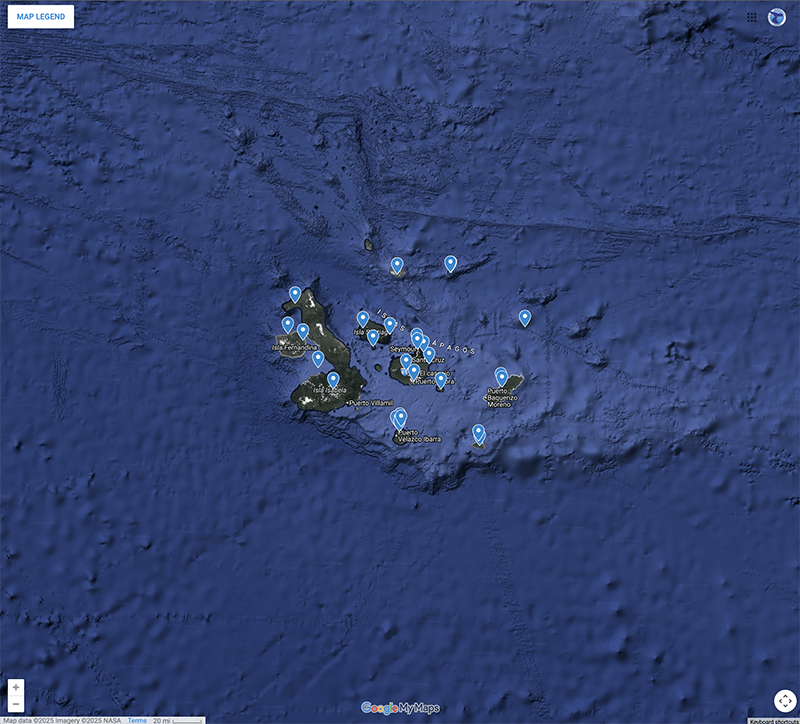
NOTABLE EXPERIENCES
 |  |
Want to learn more? Check out our blog post from our 2023 trip!
Itinerary Updated: December 2025

Ship Info
| Date | Description | Lodge | Meals |
|---|---|---|---|
| May 1 | Welcome to Quito. Arrive in Ecuador’s capital and transfer to your hotel. | Holiday Inn Quito Airport, Quito | |
| May 2 | Cloud Forest Birding Excursion. Explore Yanacocha and the Old Nono-Mino Road, with opportunities to spot the Andean Cock-of-the-rock. | Bellavista Cloud Forest Lodge, Tandayapa | B, L, D |
| May 3 | Morning at Bellavista & Return to Quito. Spend a final morning around the lodge before returning to Quito. | Holiday Inn Quito Airport, Quito | B, L, D |
| May 4 | Fly to the Galápagos & First Landing. Take a morning group flight to the Galápagos where you will be welcomed aboard the Samba. Make your first landing on Mosquera Islet. | Aboard the Samba | B, L, D |
| May 5 | Genovesa. Discover Darwin’s Bay, home to various bird species and excellent snorkeling. Get local conservation insights. | Aboard the Samba | B, L, D |
| May 6 | Marchena. Experience remote Marchena, where few travelers go. Snorkel with rays, turtles, and sharks, while keeping an eye out for passing whales. | Aboard the Samba | B, L, D |
| May 7 | Isabela. Visit Punta Albermarle’s Flightless Cormorant colony, then Punta Vicente Roca for penguins and volcanic scenery. | Aboard the Samba | B, L, D |
| May 8 | Fernandina & Isabela. Venture to Punta Espinoza, a marine iguana paradise. Continue to Urbina Bay for dramatic geology and excellent snorkeling. | Aboard the Samba | B, L, D |
| May 9 | Isabela. Cruise mangroves at Elizabeth Bay before discovering Punta Moreno’s lava fields and lagoons. | Aboard the Samba | B, L, D |
| May 10 | Floreana. Join the postcard tradition at Post Office Bay, explore Floreana’s highlands, wildlife-rich Champion Islet, then anchor in Academy Bay. | Aboard the Samba | B, L, D |
| May 11 | Santa Cruz. Observe giant tortoises in Santa Cruz’s highlands. Visit the Charles Darwin Research Station to see conservation work up close. | Aboard the Samba | B, L, D |
| May 12 | Floreana. Walk to Punta Cormorant’s flamingo lagoon, snorkel the Devil’s Crown, and end the day with views from the Baroness Lookout. | Aboard the Samba | B, L, D |
| May 13 | Española. Explore the world’s largest Waved Albatross colony on Punta Suárez. In the afternoon, snorkel at Gardner Bay. | Aboard the Samba | B, L, D |
| May 14 | San Cristóbal. Begin at Punta Pitt, where all three booby species reside. Continue to Cerro Brujo’s white-sand beach and finish the day snorkeling at Isla Lobos. | Aboard the Samba | B, L, D |
| May 15 | Santa Fé. Trek to observe the unique Santa Fé land iguana before exploring the cliffs of Plaza Sur. | Aboard the Samba | B, L, D |
| May 16 | Sombrero Chino Islet & Bartolomé. View Sombrero Chino’s lava formations from land and sea. Hike Bartolomé for panoramas of the iconic Pinnacle Rock. | Aboard the Samba | B, L, D |
| May 17 | Santiago & Rábida. Explore tidepools and the Fur Seal Grotto before walking Rábida’s red beach. Spend your final evening aboard the Samba. | Aboard the Samba | B, L, D |
| May 18 | Farewell to the Galápagos. Disembark on Seymour Norte for a final morning of wildlife viewing before flying back to Quito. | Holiday Inn Quito Airport, Quito | B |
| May 19 | Depart Home. Transfer to the airport for your flights home. | B |
Get the Full Daily Itinerary
Our Trip Leaders
![]() Juan Manuel Salcedo
Juan Manuel Salcedo
 Juan Manuel Salcedo
Juan grew up in the Galapagos Islands where he developed his passion for wildlife while sailing on his father's boat. He received a degree from the University of San Francisco, Quito after studying Applied Ecology, Biology, and Geology. Juan also earned a skipper certificate after studying sailing and navigation in Los Angeles. Involvement in Environmental Education projects in the Galapagos Islands and on mainland Ecuador fills his spare time.
Ship Information
Samba
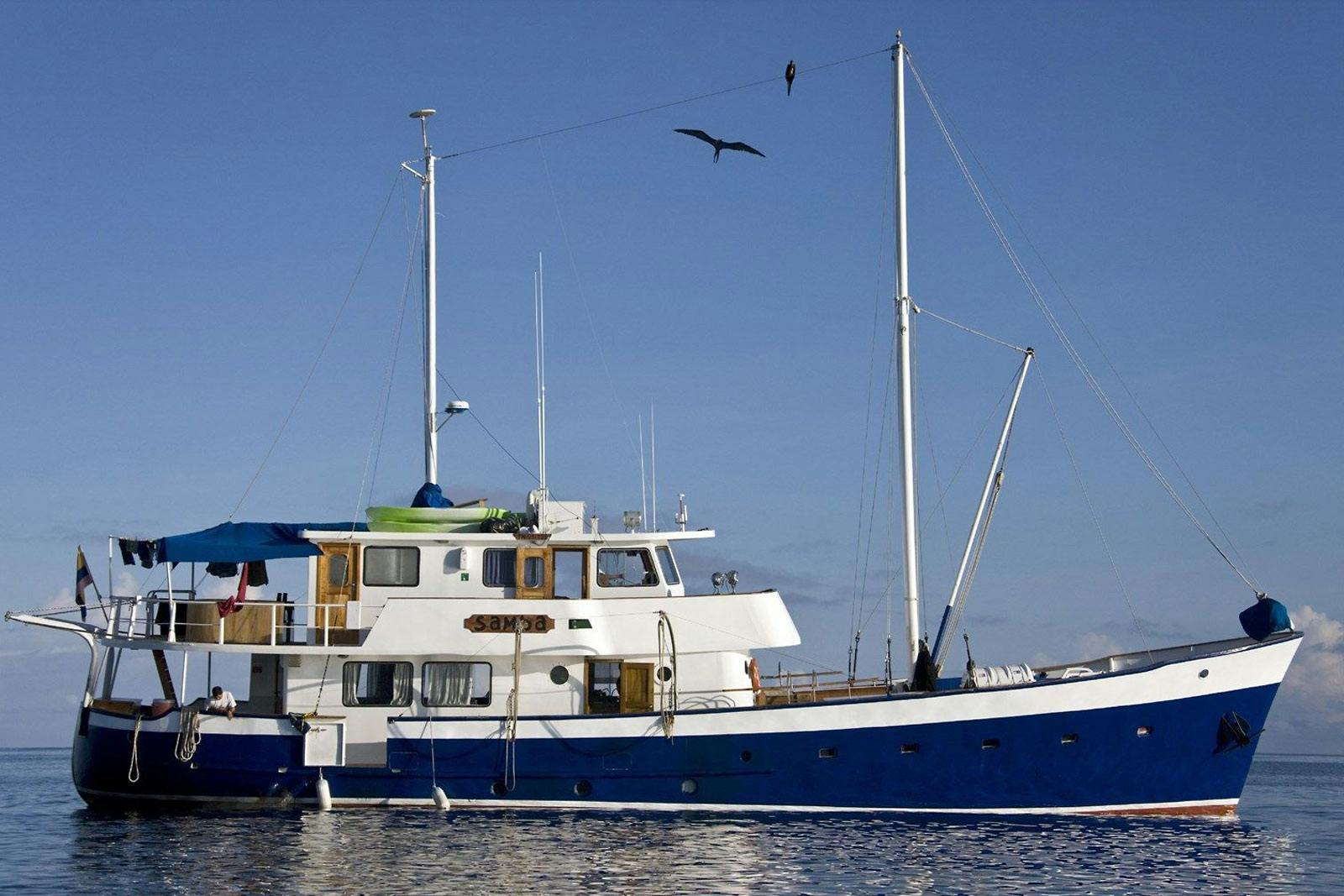
The Samba is a 78-foot steel-hulled motor yacht, built strong and stable to explore the Galápagos Islands in comfort. With her graceful European Dutch design, she combines performance, charm, and reliability for travelers seeking an intimate, immersive experience.
Her classic lines and high bow help her cut smoothly through ocean swells, ensuring a steadier ride in open waters. A stabilizing sail adds further balance, reducing motion while enhancing fuel efficiency and sailing performance. These features make the Samba ideal for reaching remote island shores and navigating with precision.
Designed for long-range ocean travel, she blends rugged construction with warm, welcoming interiors. Guests can relax and enjoy both safety and style on board. The yacht’s thoughtful layout provides excellent visibility from multiple vantage points, allowing for wildlife viewing throughout the journey.
The Samba hosts just 14 passengers, offering an exclusive, small-group experience far from crowded cruise ships. With fewer guests, the crew delivers personalized service, deeper exploration, and more time ashore. Her size and agility allow landings on smaller beaches and access to isolated coves.
Her decks provide great space for photography, birdwatching, and simply taking in the views. You’ll find comfortable cabins, cozy shared spaces, and opportunities to socialize or enjoy solitude.
Every element of Samba’s design supports the expedition spirit. Her hull handles ocean swells with ease, while her stabilizing sail keeps the voyage smooth. She’s a top choice for travelers who value sustainability, close wildlife encounters, and meaningful adventure.
Whether watching marine iguanas sunbathe or snorkeling alongside sea lions, your Galápagos experience will feel personal and profound aboard the Samba. It’s not just a cruise—it’s an intimate voyage through one of Earth’s most iconic natural wonders.
More Information
- Cost & Payments
- Included
- Not Included
- Climate
- Fitness Level
- Motion Sickness
- Flights
 Conservation
- Conditions
Cost & Payments
Costs (in US$)
| Type | Description | Cost Per Person |
|---|---|---|
| Lower Deck | Double occupancy, twin-sized upper and lower beds, private bath, and drawers for storage. | $12,550 |
| Upper Deck | Double occupancy, double bed, private bath, windows that open, closet, and drawers for storage. | $13,700 |
Costs are per person, depending on cabin type, double occupancy, not including airfare, singles extra. See Included and Not Included sections for more details.
If you are a single traveler, we will try to find a roommate for you, but if we cannot pair you with a roommate, we will not charge you a single supplement. If space is available, some cabins can be booked as a single by adding 90% over the listed cabin cost.
We cannot guarantee a specific cabin number, but if changes occur, we will assign a cabin of equal or greater value.
Payment Schedule
| Payment | Due Date | Amount Per Person |
|---|---|---|
| Deposit | Due now to reserve your space | $500 |
| Final | November 22, 2026 | Remaining balance |
Payments are due based on the schedule above. All reservations require a deposit to confirm reservation of your space.
Cancellations
Refunds are given depending on the time left before departure according to the following table. Through September 22, 2026, the cancellation fee of $300 per person can be applied toward another trip if reserved within six months of the canceled trip’s departure date. Cancellations are non-transferable.
| Dates | Forfeited Amount per Person |
|---|---|
| On or before September 22, 2026 | $300 |
| September 23 to October 22, 2026 | 10% of tour cost |
| October 23 to November 21, 2026 | 40% of tour cost |
| On or after November 22, 2026 | 100% of tour cost |
Included
- Carbon offsets for the duration of this trip.
- All leaders, transport, landing fees, and permits for all activities unless described as optional.
- Accommodations on mainland Ecuador for the nights of May 1 through May 3 and May 18.
- Fourteen nights on board the Samba.
- Meals from breakfast on May 2 through breakfast on May 19, except meals listed in Not Included section.
- Complimentary hotel airport shuttle between the Quito Airport and the Holiday Inn Quito Airport.
- Snorkel gear and full-length wetsuit on the Samba.
- The Galápagos National Park Entrance Fee and Transit Control Card.
- The Government of Ecuador fuel tax, which applies to most Galápagos vessels, does not apply to the Samba because it is a smaller, locally based, fuel-efficient vessel, using less than 3,000 gallons of diesel per month.
- Trip Planning Materials – information about entry requirements, flights, packing, gratuities, etc.
Not Included
- Carbon offsets for your flights to/from this trip.
- All airfare, airport and departure taxes, and excess baggage fees. The round-trip flights between Quito and Baltra will be added to your trip balance based on rates at the time of booking. The estimated cost is $650.
- Passport and visa fees.
- Lunch and dinner on May 18.
- Extra hotel nights.
- Gratuities.
- Mandatory emergency evacuation insurance.
- Optional trip cancellation insurance.
- Items of a personal nature such as laundry, telephone calls, medical costs or hospitalization, room service, alcoholic and other beverages, items not on the regular menu, etc. If you have special dietary needs, please indicate them on your Traveler Form.
Climate
Average temperatures range from the low to mid-60s°F (15 to 18°C) at night up to the 80s°F (26 to 31°C) during the day. The water temperature averages 70 to 74°F (21 to 23°C). Average temperatures during your mainland excursion range from nighttime lows in the 50s°F (10 to 15°C) to mid 60s°F (18°C) to daytime highs from mid 60s°F (18°C) to low 80s°F (26°C).
Fitness Level
Walks on shore vary from short strolls on the beach to a few miles over uneven terrain. If you are not accustomed to walking long distances, you will still enjoy most activities as your pace allows you to see, appreciate, and photograph the unique nature of the Galápagos. If you anticipate struggling with the walks, do some hiking beforehand to get in good shape. You must be comfortable going up and down stairs and ladders on board and getting in and out of the panga (small boat). All lower deck cabins have bunk beds, so you should also be comfortable getting in and out of a top bunk.
Although snorkeling is not mandatory, it is a significant part of the voyage as you are in the water every day, sometimes twice a day. Even if you do not have to have snorkeling experience, proficient swimming abilities will allow you to fully enjoy this activity. Most snorkeling will be panga-based, sometimes over deep water, which is not an ideal place to learn to snorkel, especially if you are uncomfortable or intimidated by these conditions. It’s beneficial to get some experience in advance, however, the Samba crew will always assist you if needed. Please contact us if you have any health concerns that may make this trip challenging.
Flights
Detailed logistical information is included in the Trip Planning Materials we will send you.
Flights you book
- Arrive in Quito, Ecuador (UIO) by 4:00pm on May 1.
- Depart from Quito, Ecuador (UIO) after 12:00am on May 19.
Flights we book
- The round-trip flights between Quito and Baltra; we’ll add the flight cost to your final trip balance.
FAQ
Accommodations
Motion Sickness
Don’t let a fear of motion sickness keep you away! Even those who have experienced seasickness reported that the incredible wildlife and overall experience were well worth the temporary discomfort. If you are susceptible to seasickness or are concerned that you might be, please come prepared! The key to avoiding seasickness is to act before you experience nausea. Do your own research and consult your doctor before taking any medications. A good night of sleep, eating well, limiting alcohol, and using your favorite seasickness remedy is sufficient for most travelers. Find more information on our Coping with Seasickness webpage (this information is applicable to any form of motion sickness) and contact us if you have any questions.
Transportation
Conservation
Our company ethos has always regarded conservation as inseparable from responsible tourism. We struggle with the dilemma that traveling worldwide expends climate-changing carbon. However, we wholeheartedly believe that traveling with us will cultivate your passion for conserving our beautiful world while stimulating each destination’s local economy. We encourage you to explore the various ways in which Cheesemans’ operates within this context:
- Ecotourism and Conservation for the Galapagos Islands
- Cheesemans’ Trips are Carbon Neutral
- Offsetting your Travel to/from our Trip: We ask you to pledge to offset the carbon emissions for your travel to and from our trips. Use this tool to calculate your emissions and purchase your carbon offset today through Sustainable Travel International, or through your favorite carbon offsetting organization.
Conditions
Read our current Terms and Conditions.